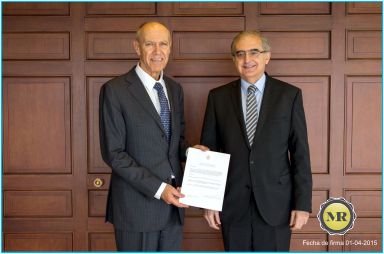
Canada is the 20th country to accede to the Marrakesh Treaty to facilitate access to published works for people who are blind, visually impaired or otherwise print disabled. With this, the Treaty will enter into force in three months' time, on September 30, 2016.
"This is very good news for visually impaired persons as well as for the multilateral intellectual property system. Once widely adopted around the world, the Marrakesh Treaty will create the framework that will open the doors to reading and knowledge in a more equal and inclusive way for people who are blind or visually impaired," said WIPO Director General Francis Gurry, adding, "I urge as many countries as possible to ratify the Treaty so that the benefits of the Treaty are available to those who need them."
"I am honored that Canada is among the countries that have brought the Marrakesh Treaty into force internationally. Together we are creating a more accessible world for people living with disabilities," said Navdeep Bains, Canada's Minister of Innovation, Science and Economic Development. He added that "the treaty's entry into force will mark the final step in the long march towards a more inclusive world in which people with visual impairments or other print disabilities can fully and actively participate in society and realize their full potential.
For her part, Ms. Carla Qualtrough, Canadian Minister of Sport and Persons with Disabilities, stated that "today is a great day in Canada's history as we become the 20th country to accede to the Marrakesh Treaty, enabling its entry into force. I am proud that our government is championing the interests of Canadians with disabilities and providing those who have difficulty reading print with more equal access to published material in accessible formats," adding that "now that the entry into force of this treaty has become a reality, Canadians will have more accessibility and choice within their communities and workplaces."
Canada's accession was preceded the previous day by those of Ecuador and Guatemala. Mr. Gurry paid tribute to the Latin American countries as they currently make up half of the number of contracting parties.
India was the first country to ratify the Treaty on June 30, 2014. "India is pleased that the 20 ratifications required for the entry into force of the Marrakesh Treaty have now been reached," said Mr. Ajit Kumar, Ambassador and Permanent Representative of India to the United Nations Office and other international organizations based in Geneva.
Expressing the hope that more countries would join these 20, he added that from now on "we will begin to see the real and tangible benefits that the Treaty offers to blind and visually impaired people around the world." More than 75 WIPO member states have signed the Treaty, which was adopted on June 27, 2013 by a diplomatic conference organized by WIPO in Marrakesh under the auspices of the Kingdom of Morocco.
Twenty accessions or ratifications are required for the Treaty to enter into force. The first 20 countries to ratify or accede were: India, El Salvador, United Arab Emirates, Mali, Uruguay, Paraguay, Singapore, Argentina, Mexico, Mongolia, Republic of Korea, Australia, Brazil, Peru, Democratic People's Republic of Korea, Israel, Chile, Ecuador, Guatemala and Canada.
June 30, 2016 is also the date of the second anniversary of the Accessible Books Consortium (ABC), which was created to implement on a practical level the objectives of the Marrakesh Treaty to Facilitate Access to Published Works for Persons Who Are Blind, Visually Impaired or Otherwise Print Disabled, through work in three areas: sharing technical capacities in developing and least developed countries to produce and distribute books in accessible formats, promoting inclusive publishing, and creating an international database for the exchange of accessible books.
The Marrakesh Treaty - An end to the "book famine".
The Marrakesh Treaty aims to remedy the "great book shortage" by requiring Contracting Parties to adopt provisions in their respective national laws to enable the reproduction, distribution and making available to the public of published works in accessible formats, such as Braille, through the application of limitations and exceptions to the rights of owners of copyrighted works.
It also provides for the cross-border exchange of copies in accessible formats through organizations that meet the needs of persons who are blind, visually impaired or otherwise print disabled. It also harmonizes limitations and exceptions so that these organizations can operate across borders. By eliminating duplication, the exchange of copies in accessible formats should increase the overall number of works available and increase efficiency.
For example, instead of five countries producing accessible versions of the same work, those five countries could produce an accessible version of a different work, which they could then exchange among themselves. The Treaty also seeks to assure authors and publishers that the system will not expose their published works to misuse or distribution to third parties other than the intended beneficiaries.
The Treaty reiterates the obligation to limit the cross-border exchange of works on the basis of limitations and exceptions to certain special cases that do not interfere with the normal exploitation of the work and do not unreasonably prejudice the legitimate interests of the right holder.
Background for the Drafting
According to the World Health Organization, there are some 285 million blind and visually impaired people in the world, 90% of them in developing countries. The results of a 2006 WIPO survey revealed that fewer than 60 countries have provisions in their national copyright laws for special limitations and exceptions for the visually impaired, for example, for Braille, large print or digital audio versions of copyrighted texts.
According to the World Blind Union, of the several million books published each year worldwide, less than 10% are made available to visually impaired people in accessible formats.
Download Treaty
Source: WIPO


